Showing posts with label Space Project. Show all posts

Wednesday, 10 October 2012

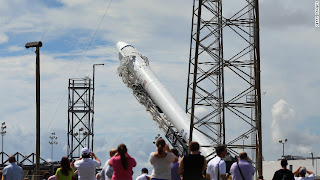
First commercial cargo flight heading to International Space Station


The SpaceX rocket, the first commercial flight to the International Space Station, lifted off October 7 carrying an unmanned cargo capsule. The Falcon 9 rocket with its Dragon capsule launched from Cape Canaveral, Florida. About 10 minutes into the flight, the Dragon separated from the rocket and was on its way to the space station. Mission control called it "a picture-perfect launch and a flawless flight of Falcon."


It is is the first of a dozen NASA-contracted flights to resupply the International Space Station, at a total cost of $1.6 billion. The launch comes nearly five months after a demonstration mission in which a Dragon capsule successfully berthed at the station and returned to Earth. 

The unmanned capsule is packed with about 1,000 pounds of cargo -- everything from low-sodium food kits to clothing and computer hard drives. It's scheduled to return in late October with about 2,000 pounds of cargo, including scientific experiments and failed equipment that can be repaired and sent back
The Dragon spacecraft is supposed to catch up with the space station early Wednesday. Station Commander Sunita Williams and Aki Hoshide from the Japanese Space Agency will use the robotic arm to grab Dragon and berth it to the station.

Much of Dragon's cargo is material to support extensive experimentation aboard the space station. One deals with plant growth. Plants on Earth use about 50% of their energy for support to overcome gravity. Researchers want to understand how the genes that control that process would operate in microgravity -- when objects are in free-fall in space. Down the road, that could benefit food supplies here on the planet. The spacecraft is also carrying nearly two dozen microgravity experiments designed and being flown through the Student Experiment Spaceflight Program.

SpaceX is not the only commercial company in the spacefaring business. Within the next few months, Orbital Sciences is expected to fly its own demonstration flight to the space station. Instead of using Cape Canaveral as its launch site, the company's rocket will take off from Wallops Island off the coast of Virginia. Orbital has a nearly $2 billion contract with NASA for station resupply missions.

SpaceX is one of three companies NASA has selected to continue work developing a human-rated spacecraft that would carry astronauts to the International Space Station. Boeing and Sierra Nevada are the other two companies.The SpaceX plan is to modify the Dragon capsule to carry people
+

Sunday, 30 September 2012

India's heaviest satellite GSAT-10 successfully launched


 According to an ISRO Press release, the ISRO-built GSAT-10 is the heaviest satellite so far weighing 3,400 kg and was injected into an elliptical Geosynchronous Transfer Orbit (GTO).

According to the Press release, the ISROs Master Control Facility (MCF) took over the command and control of the GSAT-10 immediately after the injection. "Preliminary checks on various subsystems of the satellite, namely, power, thermal, command, sensors, controls, etc., were performed and all the parameters were found satisfactory. Following which, the satellite was oriented towards the earth and the sun using the onboard propulsion system.


"In the upcoming days, orbit raising manoeuvres would be performed to place the satellite in the Geostationary Orbit, with required inclination with reference to the equator. The satellite would be moved to the Geostationary Orbit (36,000 km above the equator) by using the satellite propulsion system with a three-step approach," the ISRO release said.

After the completion of the orbit raising operations, the two solar panels and both the dual-gridded antenna reflectors of GSAT-10 would be deployed for further tests and operations. It is planned to experimentally turn on the communication payloads in the second week of October.

After the successful completion of all in-orbit tests, GSAT-10 would be ready for operational use by November. GSAT-10 would be positioned at 83 degree East orbital location along with INSAT-4A and GSAT-12. The operational life of GSAT-10 is expected to be 15 years nominal.

GSAT-10 Satellite has 30 Communication Transponders [12 in Ku-band, 12 in C-band and 6 in Extended C-Band]. Besides, it has a Navigation payload GAGAN that would provide GPS signals of improved accuracy (of better than 7 meters) to be used by the Airports Authority of India for Civil Aviation requirements. GSAT-10 is the second satellite in INSAT/GSAT constellation with GAGAN payload after GSAT-8, launched in May 2011.

Watch Video
+